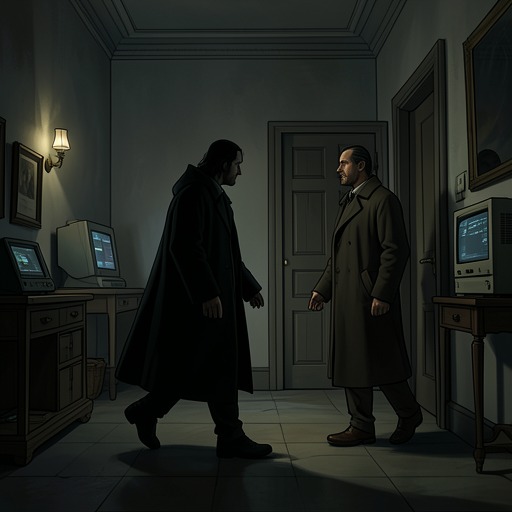
d'Artagnan and the man of Meung
The Three Musketeersd'Artagnan and the man of Meung are bound by an antagonism that begins in misunderstanding but becomes one of the novel's first durable conflict lines. At the Jolly Miller Inn in Meung, d'Artagnan interprets a stranger's laughter over his horse as a personal insult; the resulting challenge exposes his youthful susceptibility, while the stranger's composure and concealed political purpose establish him as an opponent far more dangerous than the immediate quarrel suggests.
The First Encounter and Its Misunderstanding
The hostility grows out of d'Artagnan's habit of reading every smile as an insult and every glance as a provocation. Arriving from Tarbes on a poor pony, with a sword of respectable length and an aggressively watchful expression, he is already prepared to defend his dignity. At the Jolly Miller, he sees a well-made, stern-looking gentleman speaking with two respectful listeners. Their repeated laughter appears to concern d'Artagnan, although the subject is actually his horse. The young Gascon nonetheless fixes his haughty gaze upon the stranger and studies him with unusual precision: the man is about forty to forty-five, with black piercing eyes, a pale complexion, a strongly marked nose, and a black, well-shaped mustache. His violet doublet and hose are new but creased like traveling clothes long packed away. D'Artagnan instinctively senses that this stranger will influence his future.
The scene converts wounded pride into physical danger. D'Artagnan follows the departing man with his sword drawn and calls upon him to turn lest he be struck from behind. The stranger responds with astonishment and contempt, treating the young challenger as mad, yet he also recognizes that d'Artagnan's reckless courage might suit the king's Musketeers. When d'Artagnan launches a furious thrust, the stranger draws his own sword and takes guard seriously. Before their duel can proceed, however, the stranger's companions and the host attack d'Artagnan with sticks, shovels, and tongs. The stranger sheaths his weapon and watches impassively while d'Artagnan refuses to retreat, dismissing the young Gascon's defiance as another Gasconade.
From Personal Insult to Political Suspicion
The stranger's interest changes once he learns that d'Artagnan carries a letter addressed to M. de Treville, captain of the Musketeers. While d'Artagnan lies wounded, the stranger asks what is in the young man's pocket and becomes visibly troubled when the letter's destination is disclosed. He wonders whether M. de Treville has deliberately set this young Gascon against him. Although d'Artagnan is young, the stranger recognizes that a sword thrust is dangerous at any age and that a youth may be less suspected than an older agent. His remark that a weak obstacle can overthrow a great design reveals that the encounter has touched a larger plan rather than merely his vanity.
He asks the host to remove the “frantic boy,” saying that he cannot kill d'Artagnan but that the young man annoys him. The evasion does not end the quarrel. When the stranger proposes returning to Paris without chastising the insolent youth, a woman challenges that decision, and d'Artagnan, having overheard the exchange, bursts through the doorway to declare that the insolent boy chastises others. His repeated pursuit of the stranger therefore becomes both a personal vow and an unconscious response to a political threat whose nature he does not yet understand.
The Pursuit in Paris
After reaching Paris, d'Artagnan recounts the adventure of Meung to M. de Treville with warmth and exactness. The account delights M. de Treville, but the captain immediately becomes serious when d'Artagnan identifies the woman associated with the stranger as Milady. M. de Treville realizes that the man is not an ordinary traveler and believes him to be Rochefort, whom he had thought still at Brussels. He warns d'Artagnan not to confront Rochefort if he sees him in the street, advising him to pass on the opposite side because Rochefort would break him like glass.
The warning only intensifies d'Artagnan's determination. He offers to abandon even M. de Treville's promised letter of recommendation if that is what revenge requires. M. de Treville's attempt to give him the recommendation is interrupted when d'Artagnan suddenly sees the man he believes to be his thief and rushes from the cabinet crying that the traitor shall not escape. Later, a citizen describes the cardinal's agent as a nobleman of lofty carriage, with black hair, a swarthy complexion, piercing eyes, white teeth, and a scar on his temple. D'Artagnan immediately recognizes the description as his man of Meung. When the cloaked figure appears across the street, d'Artagnan and the citizen identify him simultaneously, and d'Artagnan again draws his sword and pursues him, separating from Athos and Porthos on the staircase.
Rochefort as the Hidden Adversary
The relationship's decisive reversal is the recognition that the man of Meung is Rochefort, a creature of Cardinal Richelieu and his “evil genius.” What first seems to be a quarrel over laughter and a bad horse is thus connected to the political machinery opposing d'Artagnan's circle. Rochefort's concealment, his knowledge of M. de Treville, his concern over d'Artagnan's letter, and his association with Milady all transform him into a recurring emblem of surveillance and obstruction. D'Artagnan initially pursues him as a thief of his passport and an offender against his honor; the larger story makes clear that Rochefort belongs to the network through which political danger reaches the young Gascon.
Their conflict also contrasts two forms of power. D'Artagnan acts openly, impetuously, and physically, announcing his challenge and accepting immediate danger. Rochefort acts through disguise, intelligence, strategic withdrawal, and political affiliation. Even when he is armed, he can turn a duel into a spectacle and let others do the fighting. The opposition therefore places d'Artagnan's directness against Rochefort's calculated mobility, while making the young man's pursuit an early lesson in the difference between a visible insult and an invisible conspiracy.
Persistence, Reversals, and Consequences
Although Rochefort repeatedly escapes immediate capture, d'Artagnan's pursuit does not become meaningless. His refusal to let the first encounter disappear propels him toward M. de Treville, the Musketeers, and the courtly conflicts in which personal courage is inseparable from political loyalty. The quarrel at Meung is the initiating wound of a much wider career: it gives d'Artagnan an enemy, a mystery, and a reason to interpret subsequent events as part of a connected opposition.
The relationship is also marked by repeated reversals in which d'Artagnan's personal vendetta intersects with royal and cardinal politics. King Louis XIII later rewards d'Artagnan with forty pistoles after hearing of the Musketeers' revenge for the Rue Férou, confirming that the young man's daring can earn royal favor even while he remains entangled in conflicts shaped by Cardinal Richelieu. The novel similarly surrounds d'Artagnan with politically charged gifts: Anne of Austria entrusts Buckingham with a rosewood casket bearing her cipher; Buckingham provides replacement diamond studs when the originals are endangered; and the queen's diamond, delivered directly to d'Artagnan, becomes a token of trust rather than an enemy's deceit. These exchanges underline the stakes that Rochefort's world represents: letters, jewels, money, protection, and official commissions circulate as instruments of allegiance and danger.
The conflict's eventual significance lies less in a single completed revenge than in the way it establishes d'Artagnan's pattern of action. He sees, recognizes, challenges, and pursues before he fully understands. Rochefort, meanwhile, is first perceived as a mocking stranger and only later as a political agent. Their antagonism therefore joins the novel's themes of honor, disguise, and social advancement: a young man seeking entry into the Musketeers mistakes a strategic adversary for a personal offender, yet that mistake becomes the first step toward discovering the hidden structures governing his new life. D'Artagnan's later receipt of a lieutenant's commission from Cardinal Richelieu, written on a sealed carte blanche with the name left for him to complete, shows how far he has traveled from the wounded traveler at Meung. The man who first blocked his path remains the shadow cast by that transformation—from impulsive challenger to a figure recognized by both royal and cardinal power.